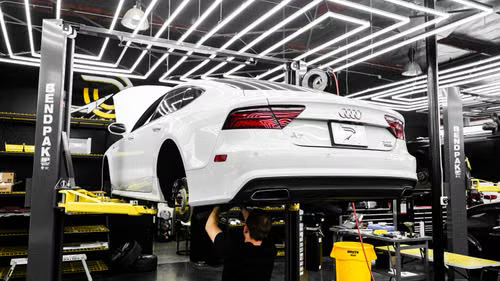
Walk through a modern collision facility, and you will notice something odd. Part of the floor sits behind a curtain or a wall, with its own tools hanging on its own rack. That partition is not decoration. An auto body shop separates aluminum work from steel work because mixing the two can damage cars and create a fire risk most owners never think about. Your hood, your tailgate, or even your entire body structure could be aluminum, depending on what you drive.
Owners rarely ask an auto body shop about metal separation. They ask about timelines and color matching. Yet this one detail quietly decides whether your paint still looks right in three years or starts bubbling from underneath. Here is why.
Galvanic Corrosion Explained Without the Chemistry Lecture
Put two different metals together, add a little moisture, and one of them starts giving up electrons to the other. The less noble metal corrodes. Aluminum sitting against mild or stainless steel loses that exchange.
Now picture a technician grinding steel across the shop. That dust travels. It settles on every surface nearby, including an aluminum panel waiting for paint twenty feet away.
One embedded steel particle becomes a corrosion site. It grows outward under the clear coat, slowly, until the paint blisters from below. By the time you see it, the damage started a year or two earlier.
Interesting reversal worth mentioning, though it goes the other direction. Aluminum corrodes galvanized steel. The relationship is not symmetrical, which trips up people who assume dissimilar metals generally fight each other.
See also: Membership Rewards Explained: Getting the Most From Loyalty Ecosystems
Aluminum Dust Is a Fire Hazard, Not Just a Contaminant
The second reason for separation has nothing to do with corrosion.
The Aluminum Association reports that testing dust generated during automotive collision repair confirmed that both steel and aluminum dusts present a combustibility hazard that requires management. Particle size matters. Anything below 420 microns raises the risk, and sanding produces exactly that size range.
A reaction called thermite is also possible. Aluminum pulls oxygen away from rust, reducing iron oxide back toward iron and releasing heat as it goes. Mixing the two dusts in a collection system invites trouble.
Guidance on handling is direct:
- Standard shop vacuums are not recommended and can increase the hazard.
- Wet dust collection suits the smaller quantities a collision shop produces
- Dusts from steel and aluminum should never mix in the same collector.
- Equipment used on one metal needs decontamination before touching the other.
- Collected dust gets emptied often rather than allowed to build up.
Ford drew attention to this when the aluminum F-150 arrived, recommending wet mix vacuum or central extraction systems for aluminum dust.
What Separate Tools Mean in a Real Repair Bay
Separation goes past the room itself. A shop doing aluminum work correctly keeps a parallel set of equipment that never crosses over.
That typically means dedicated sanders, dedicated abrasive discs, stainless or aluminum wire brushes instead of carbon steel, and plastic- or aluminum-faced hammers and dollies. Work surfaces stay separate too. Many shops color-code the aluminum tools so nobody grabs the wrong sander on a busy afternoon.
Fasteners follow the same logic. Steel rivets or bolts pressed directly into aluminum panels create their own corrosion cells. Correct repairs use aluminum or stainless fasteners, or a corrosion-inhibiting sealant between the two surfaces.
Small stuff, all of it. Small stuff is what fails first.
Which Vehicles Actually Need Aluminum Protocols
You might assume this applies only to exotics. Not really.
Aluminum shows up in hoods, fenders, doors, roofs, and closure panels across mainstream models. Some trucks use aluminum bodies outright. Luxury and performance brands go further, with aluminum-intensive structures throughout.
Relux Collision maintains brand-specific repair pages for Audi, Bentley, BMW, Ferrari, Lamborghini, Land Rover, McLaren, Mercedes-Benz, Porsche and Tesla, alongside everyday work on Ford, Toyota, Honda and Chevrolet. Several of those manufacturers build aluminum-heavy vehicles, and their published procedures spell out how repairs must happen.
The shop pulls those procedures through AirPro Diagnostics, which gives technicians access to OEM software and current repair information without sending the car elsewhere. Blueprinting happens after disassembly, usually within one to three hours, and that plan goes to your insurer before ordering parts.
What Correct Metal Handling Protects
Think about what a contaminated aluminum panel actually costs you. Refinishing that fails early. Structural components weakened where you cannot see them. Resale value knocked down when a buyer spots blistered paint on a five-year-old car.
Relux Collision holds I-CAR Gold Class recognition and employs I-CAR, BASF, and ASE-certified technicians. We mix paint from your factory code using BASF color data and blend it into surrounding panels. Completed repairs carry a limited lifetime warranty, and the Relux Cash Back program offers deductible assistance of up to $1,000.
Bring your vehicle to the Asher Lane facility in Sacramento for a free estimate before work starts.